
Ganesh Ji History: Lesser-Known Legends and Hidden Meaning | Lord Ganesha Wooden Idol 3×4 Inch HD Printed Table Decor for Home Temple Royal Darshan
May 17, 2026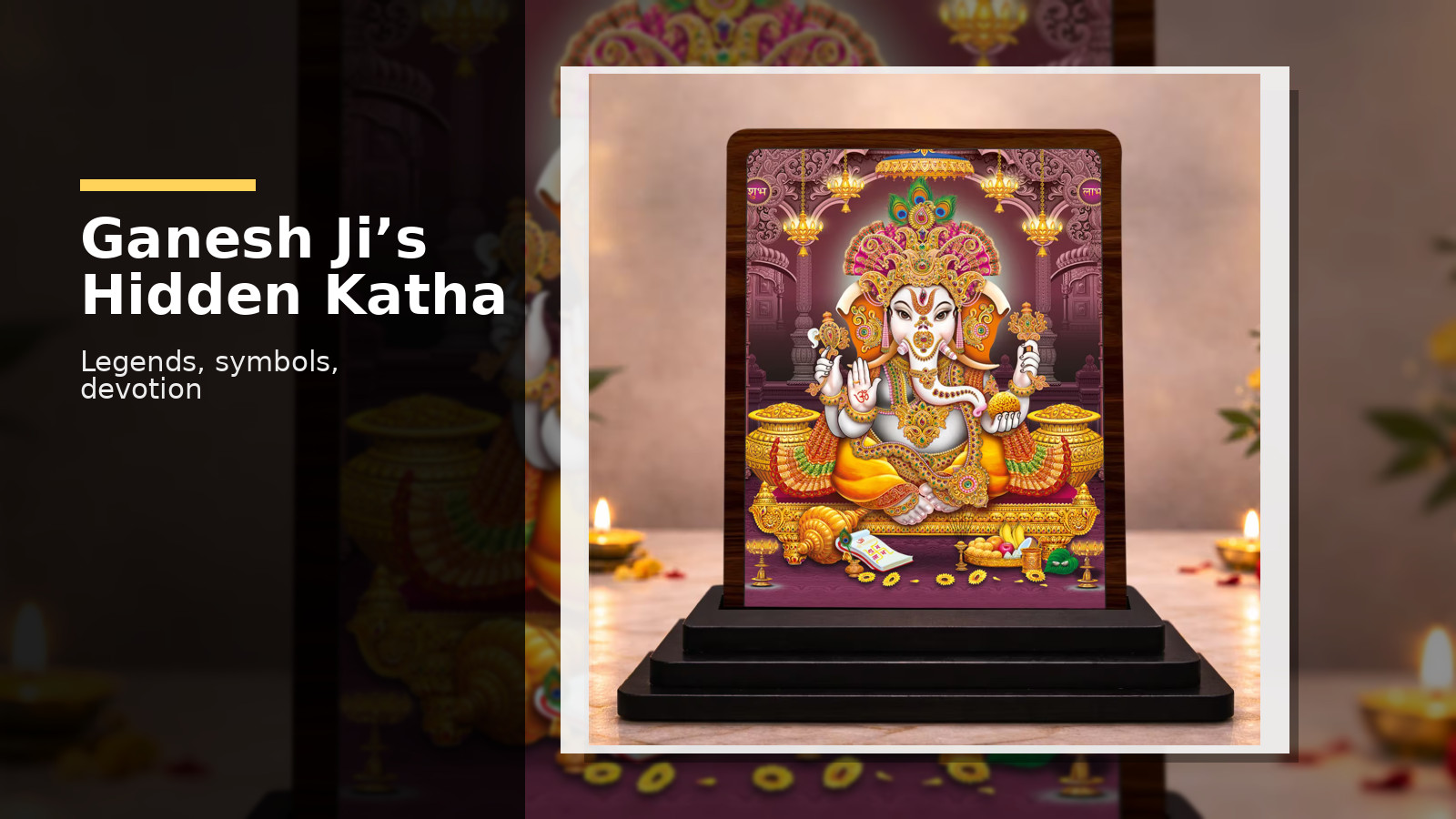
English Version
When people speak of ganesh ji history, the familiar stories often come first: the beloved son of Shiva and Parvati, the remover of obstacles, the first deity worshipped before a new beginning. But beneath these well-known blessings lies a softer, more intimate world of lesser-known legends and symbolic meanings. It is in these quiet corners of the tradition that Ganesh Ji feels especially close to ordinary devotees—gentle, wise, and deeply human in the way divine stories are told.
That is why Ganesh Ji’s story has never stayed limited to one grand tale. It has grown like a lamp passed from hand to hand, through family devotion, village worship, temple customs, and the lived faith of countless homes. Every generation has found something of itself in Him: a child’s innocence, a mother’s love, a scholar’s wisdom, and a devotee’s hope.
Who is Ganesh Ji in Hindu devotion?
Lord Ganesha is worshipped as the first among the gods invoked at the start of auspicious work. In homes, temples, shops, and offices, devotees begin with His name because He represents a smooth path, calm wisdom, and the strength to overcome difficulty.
His form is filled with meaning. The elephant head suggests intelligence and memory. The large ears remind us to listen more and speak less. The small eyes point toward focus. The trunk shows flexibility, because life often asks us to bend without breaking. Even His vehicle, the mouse, carries a deep lesson: desire is restless and small, but when guided by wisdom, it can be controlled.
This is why the devotion to Ganesh Ji is not only about ritual. It is also about inner discipline, humility, and gratitude.
A lesser-known thread in Ganesh Ji history
One of the most touching parts of ganesh ji history is not just the dramatic beginnings, but the many side-stories that devotees sometimes hear only in passing. These smaller traditions often reveal how closely people felt the presence of Ganesh Ji in daily life.
For example, in many devotional retellings, Ganesh Ji is not only the mighty remover of obstacles but also the one who understands the small troubles of ordinary life. A delayed task, a worried parent, a nervous student, a household beginning a new venture—these are the moments in which devotees naturally turn to Him. That closeness is part of His sacred charm. He is grand, yet never distant.
Another beloved side-story in the larger tradition is about His role as the one who listens first. Before action comes attention; before success comes awareness. This is why many devotees see Ganesha not only as a deity of completion, but also as the guardian of beginnings.
The deeper meaning behind His forms
Ganesh Ji’s iconography is full of symbolism of Lord Ganesha. Nothing in His form is accidental in the devotional imagination.
- Elephant head: wisdom, steadiness, and memory
- Single tusk: the power to preserve what matters and let go of what does not
- Large belly: the ability to hold joy, sorrow, and all of life with equanimity
- Mouse as vahana: control over restless desire
- Modak in hand: the sweetness of spiritual reward
- Raised blessing hand: reassurance, protection, and grace
Seen this way, Ganesh Ji becomes more than a figure in art or ritual. He becomes a teaching in form. Devotees do not merely bow before Him; they learn from Him.
Why ordinary devotees felt close to Ganesh Ji from the beginning
One reason Ganesh Ji has remained so loved across homes and regions is that He speaks to everyday life. He is present where people begin something with hope and a little fear. A child starting school, a mother preparing for a festival, a family opening a business, a devotee lighting the first lamp in the morning—these moments all carry the same quiet prayer: may this path open well.
Ganesh Ji’s history is deeply devotional because it is deeply relational. He is remembered in stories of family love, respectful discipline, and the tender bond between divine parents and their child. Yet beyond the famous family narrative, devotees have also felt Him as a friend of the household, a protector of thresholds, and a remover of hidden inner obstacles such as doubt, pride, and restlessness.
Ganesh Chaturthi and the joy of public devotion
No discussion of ganesh ji history feels complete without mentioning Ganesh Chaturthi significance. This festival turns homes and neighborhoods into spaces of shared devotion. The idol is welcomed with music, flowers, prayers, and offerings, and for a few sacred days or longer, the whole atmosphere changes.
The beauty of Ganesh Chaturthi lies in its balance of celebration and surrender. Devotees rejoice in the arrival of the beloved deity, yet they also remember the deeper truth of impermanence. The immersion ceremony, moving and reflective, gently teaches that divine presence is not limited to form. It lives in memory, practice, and devotion.
That is why the festival feels emotionally powerful: it is both festive and philosophical, both joyful and humble.
Famous temples and sacred places linked with Ganesh Ji
Across India, several temples hold a special place in the hearts of devotees who seek the blessings of Ganesha. These sacred places add living texture to ganesh ji history.
- Siddhivinayak Temple, Mumbai: one of the most visited and beloved Ganesh temples
- Dagdusheth Halwai Ganpati, Pune: famous for its vibrant devotion and public celebration
- Ashtavinayak temples in Maharashtra: a revered pilgrimage circuit dedicated to eight forms of Ganesha
- Kanipakam Vinayaka Temple, Andhra Pradesh: widely respected by devotees for its ancient spiritual atmosphere
These temples are not just places to visit. They are places where faith becomes visible—through lamps, chants, flowers, and the steady hope carried by pilgrims.
Hidden lessons devotees often miss
The quieter side of Ganesh Ji’s stories carries lessons that are easy to overlook:
- Wisdom is stronger than speed.
- Listening is often more powerful than speaking.
- Letting go can be a sacred act.
- Beginnings matter, but inner purity matters more.
- True strength can appear gentle.
These teachings are why Ganesh Ji is loved not only as a remover of obstacles, but also as a guide for character. His presence reminds devotees to begin with humility and continue with steadiness.
Devotional importance in daily life
In many homes, Ganesh Ji is not remembered only during festivals. He is part of everyday prayer, morning rituals, business beginnings, and family milestones. A small murti placed in a pooja corner becomes a daily point of focus—something simple, calm, and spiritually warm.
For devotees who like to keep a serene reminder of this presence at home or at work, a compact devotional idol can help create that atmosphere. A thoughtfully made piece such as the Lord Ganesha Wooden Idol 3×4 Inch HD Printed Table Decor for Home Temple Royal Darshan can softly support a prayer space, desk, or shelf with a gentle devotional touch.
FAQ: Common questions about Ganesh Ji history
Why is Ganesh Ji worshipped first?
Devotees worship Ganesh Ji first because He is believed to remove obstacles and bless new beginnings with wisdom and smooth progress.
What does the mouse of Ganesha symbolize?
The mouse symbolizes restless desire and the mind’s impulses. Ganesh Ji riding it shows the power of wisdom over uncontrolled urge.
What is the deeper meaning of the single tusk?
The single tusk is often seen as a symbol of sacrifice, focus, and the ability to keep what is essential while releasing what is not.
Why is Ganesh Chaturthi so important?
Ganesh Chaturthi celebrates the arrival of Ganesh Ji with joy, devotion, and community worship. It also reflects the deeper truth of divine presence beyond physical form.
Which temples are most famous for Ganesh Ji darshan?
Siddhivinayak in Mumbai, Dagdusheth Halwai Ganpati in Pune, and the Ashtavinayak temples in Maharashtra are among the most loved places for Ganesh Ji darshan.
Hindi Version
Jab hum ganesh ji history ke baare mein baat karte hain, to sabse pehle wahi pyari aur jana-pehchana katha yaad aati hai: Shiva aur Parvati ke putra, vighnaharta, aur har shubh kaam se pehle puje jaane wale Ganesh Ji. Lekin is prasiddh katha ke peeche ek aur komal aur gehri duniya bhi hai—lesser-known legends aur unka hidden symbolism. Yahi woh jagah hai jahan Ganesh Ji aur bhi kareeb lagte hain—ek aise devta jo bade bhi hain aur apne se lagte bhi hain.
Ganesh Ji ki kahani sirf ek maha-katha nahi hai. Yeh gharon ki diya-ghar ki roshni, mandiron ke ghanti-naam, aur bhakt ke man ki chhoti-chhoti aas ka safar hai. Har peedhi ne inmein apni koi na koi bhavna dekhi hai—bacche ki nishchalta, maa ki mamta, vidwan ki buddhi, aur bhakt ki vinamr aastha.
Ganesh Ji kaun hain?
Ganesh Ji ko Hindu dharm mein sabse pehle amantrit kiya jaata hai. Naye kaam, naye ghar, vyapar, vidya-prarambh ya kisi bhi shubh aarambh mein unka naam liya jaata hai, taaki raah saral ho aur mann sthir rahe.
Unka roop bhi apne aap mein ek updesh hai. Hathi ka sir buddhi aur smriti ka sanket hai. Bade kaan humein sunne ki vinamrata sikhate hain. Chhoti aankhen ekagrata ka sandesh deti hain. Soond lachilapan sikhati hai—zindagi mein kabhi-kabhi jhukna padta hai, tootna nahi. Aur mooshak batata hai ki iccha aur chanchalta ko vivek se niyantrit kiya ja sakta hai.
Ganesh Ji history ka ek kam suna gaya pehlu
ganesh ji history ka sabse sundar pehlu ye hai ki ismein sirf bade aur prasiddh prasang hi nahi, balki kuch side-stories bhi hain jo bhakton ko bahut apne lagte hain. In chhoti kathao mein Ganesh Ji ghar-ghar ke devta se zyada mehsoos hote hain—jaise woh har roz ki pareshani samajhte ho.
Der se hota kaam, bacche ka pehla din, dukaan ka naya aarambh, parivar ki chinta—aise har pal mein bhakt unki or mudta hai. Yahi unki karuna hai: ve badi kathao ke devta hote hue bhi chhoti chhoti chintao ke saathi lagte hain.
Unke roop ka gehra arth
Ganesh Ji ke symbolism of Lord Ganesha mein har ang ka apna sandesh hai.
- Hathi ka sir: buddhi, sthirta, smriti
- Ek dant: jo avashyak hai use bachana, jo anavashyak hai use chhod dena
- Bada pet: jeevan ke sukh-dukh ko samaan bhav se sametna
- Mooshak vahan: bechain ichchha par niyantran
- Modak: bhakti ke phal ki mithas
- Abhay mudra: aashwasan, raksha aur kripa
Is drishti se dekhen to Ganesh Ji sirf murti nahi, ek jeevant shiksha hain.
Aam bhakton ko Ganesh Ji itne apne kyon lagte hain?
Kyoki Ganesh Ji jeevan ki shuruaat se jude hain. Baccha school ja raha ho, maa tyohar ki taiyari kar rahi ho, parivar naya kaam shuru kar raha ho—har jagah ek hi prarthana hoti hai: “hey Ganpati Bappa, raah khol dijiye.”
Isi liye Ganesh Ji ki history bhakti se bhari hai. Unka sambandh sirf katha se nahi, parivar, sanskar aur rozmarra ki aastha se bhi hai. Ve ghar ke rakshak, dehleez ke devta aur mann ke andar chhupe vighnon—jaise ahankar, sandeh aur chanchalta—ke harta bhi hain.
Ganesh Chaturthi ka mahatva
Ganesh Chaturthi significance Ganesh Ji ke jeevan aur bhakti mein bahut khaas hai. Is parv mein ghar aur mohallay bhakti ke rang se bhar jaate hain. Aarti, phool, modak, aur “Ganpati Bappa Morya” ke naad se mahoul bhavya ho jaata hai.
Is utsav ki sundarta ye hai ki yeh khushi aur virakti dono sikhata hai. Aagman ka harsh hota hai, aur visarjan ke pal humein yaad dilate hain ki divine presence roop tak seemit nahi. Bhakti yaad, sewa aur anusaran mein jeevit rehti hai.
Ganesh Ji se jude prasiddh mandir
Desh bhar mein kai aise sthaan hain jahan Ganesh Ji ke darshan ka vishesh mahatva hai.
- Siddhivinayak Temple, Mumbai: atyant prakhyat aur priya Ganesh mandir
- Dagdusheth Halwai Ganpati, Pune: bhavya bhakti aur jan-samuh ki shraddha ka kendra
- Ashtavinayak yatra, Maharashtra: Ganesh Ji ke aath roopon ka pavitra teerth
- Kanipakam Vinayaka Temple, Andhra Pradesh: prachin aur gahri aadhyatmik anubhuti wala sthaan
Yeh mandir sirf darshan sthal nahi, balki bhakti ko jeeta-jaagta roop dene wale pavitra kendra hain.
Bhakt jo chhupa hua sandesh kabhi-kabhi miss kar dete hain
Ganesh Ji ki kathayein humein kuch bahut hi kaam ki baatein sikhati hain:
- Jaldi se zyada buddhi mahatvapurn hai.
- Sunna, bolne se adhik shaktishali ho sakta hai.
- Chhodna bhi ek pavitra kriya ho sakti hai.
- Shuruaat mahatvapurn hai, par antar ki shuddhi aur bhi mahatvapurn hai.
- Sachchi shakti kabhi-kabhi komal roop mein aati hai.
Yahi karan hai ki Ganesh Ji sirf vighnaharta nahi, balki charitra ke margdarshak bhi hain.
Rozmarra ki bhakti mein Ganesh Ji
Kayi gharon mein Ganesh Ji sirf tyohar par nahi, har roz puje jaate hain. Subah ki aarti, pooja-kaksh, naye kaam ki shuruaat, ya parivarik utsav—sab jagah unki upasthiti mehsoos hoti hai.
Jo log apne ghar ya kaam ki jagah par ek shaant aur bhavpoorn smaran rakhna chahte hain, unke liye ek chhota aur sundar devotional piece kaafi maayne rakhta hai. Aise mein Lord Ganesha Wooden Idol 3×4 Inch HD Printed Table Decor for Home Temple Royal Darshan jaise compact idol se pooja-sthan, desk ya shelf mein komal bhakti ka sparsh aata hai.
FAQ: Ganesh Ji history se jude prashn
Ganesh Ji ki pooja pehle kyon hoti hai?
Kyunki unhe vighn harta aur naye aarambh ka rakshak maana jaata hai. Isliye kisi bhi shubh kaam se pehle unka smaran kiya jaata hai.
Ganesh Ji ka mooshak kya dikhata hai?
Mooshak bechain ichchha aur mann ki chanchalta ka sanket hai. Ganesh Ji par savar mooshak dikhata hai ki buddhi iccha par vijay pa sakti hai.
Ek dant ka kya arth hai?
Ek dant tyag, ekagrata aur anavashyak ko chhodkar mahatvapurn ko apnane ka sandesh deta hai.
Ganesh Chaturthi itni mahatvapurn kyon hai?
Yeh parv Ganesh Ji ke aagman, bhakti, samudayik utsav aur divine presence ke gahre arth ko celebrate karta hai.
Ganesh Ji ke prasiddh mandir kaun se hain?
Siddhivinayak, Dagdusheth Halwai Ganpati, aur Ashtavinayak mandir sabse priya aur prasiddh sthalon mein gine jaate hain.