
Shiv Ji History: Forgotten Stories, Sacred Symbols, and Devotion
April 20, 2026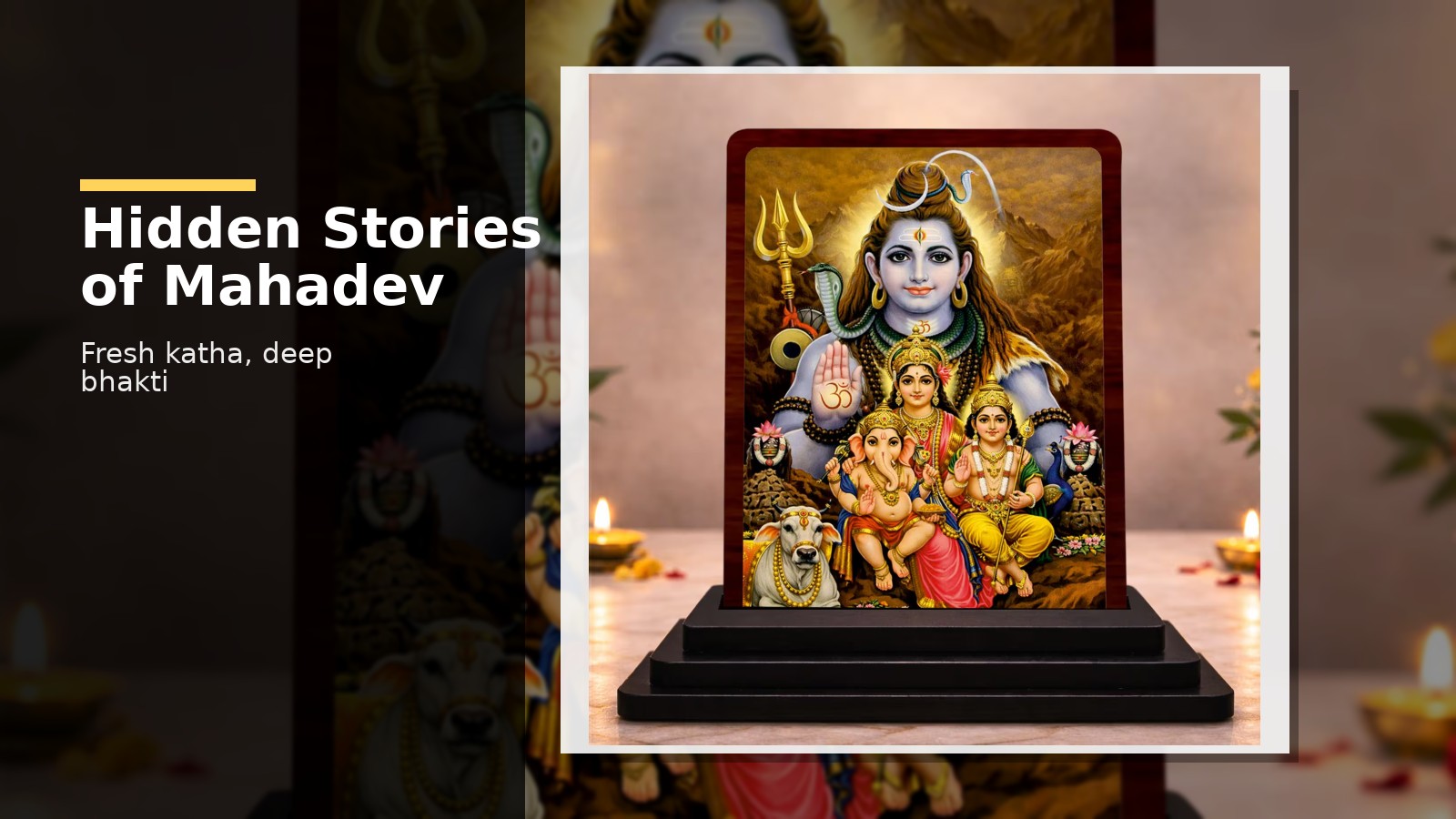
English Version
Shiv Ji history is not only the story of a deity who sits in silence on Kailash. It is also the story of hidden kindness, unexpected compassion, and symbols that look simple at first but carry a whole universe inside them. When elders tell Shiv Ji ki katha, they do not always begin with grand wars or royal tales. Sometimes they begin with a trishul, a little river water, a bilva leaf, or a quiet belief that Mahadev listens even when words fail.
That is why Shiv Ji feels so close to ordinary devotees. He is both fierce and soft, both the destroyer of illusion and the shelter of every tired heart. In the lesser-known stories of Shiv Ji, one notices something beautiful: the Lord does not always appear in loud miracles. Often, He reveals Himself through a small symbol, a humble ritual, or a moment of deep surrender.
Who is Shiv Ji in devotional memory?
In Hindu tradition, Shiv Ji is revered as Mahadev, Bholenath, and Shankar. He is seen as the one who holds creation, destruction, meditation, and mercy together. Unlike kings who demand splendor, Shiv Ji accepts even the simplest offering. A little water, a leaf, sincere chanting—these are enough for Him.
This is one reason devotees love Him so deeply. He is not distant. He is the Lord who understands grief, patience, renunciation, and family life. The stories around Shiv Ji history often show that He is not just a cosmic force, but a presence that lives in devotion, in household prayer, and in the emotional memory of generations.
The forgotten symbol that quietly speaks: the bilva leaf
Among the many sacred signs connected with Mahadev, the bilva leaf is one of the most loved and yet often overlooked in its full meaning. A devotee may place it gently on the Shivling, but behind that small act lies a deep devotional world.
According to long-standing tradition, the three leaves are often remembered as symbols of the three gunas, the three eyes of Shiv Ji, and the balance needed in life. The leaf is not decorative. It is a message. It says that devotion does not need luxury; it needs sincerity.
Many families still teach children to offer bilva leaves with folded hands and a calm mind. In that small ritual, Shiv Ji history becomes living history—not something locked in a book, but something breathed into prayer every morning.
Lesser-known kathayein that make Mahadev feel near
There are well-known stories of Shiv Ji, but there are also quieter ones that people remember with emotion. These are the kinds of legends that are often spoken in kitchens, on temple steps, or during rainy evenings when the sound of bells mixes with the scent of incense.
- Neelkanth’s compassion: The story of Shiv Ji holding the poison during the churning of the ocean is famous, but the emotional core of the tale is often missed. He did not take the poison for fame; He took it for the world’s safety. That is why devotees call Him the one who absorbs suffering.
- Ganga on His hair: The descent of Ganga onto Shiv Ji’s matted locks is not only a mythic image. It also shows His power to contain force without breaking under it. In bhakti, this becomes a lesson in grace under pressure.
- His love for simple devotion: Many stories tell us that Shiv Ji responds to sincerity, even when the devotee is socially humble or spiritually untrained. This makes Him the Lord of the common heart.
- The half-open eyes of meditation: Shiva is often imagined in deep samadhi. That quiet face teaches devotees that stillness can be powerful, and silence can be full of meaning.
These stories are not just ancient tales. They are emotional mirrors. People see their own pain, hope, and surrender in them.
Why the Shivling is central to Shiv Ji history
One of the most discussed yet sometimes misunderstood sacred forms is the Shivling. For many devotees, it is not merely an icon; it is a sign of the formless divine presence. It reminds us that Mahadev cannot be limited by human shape alone.
The Shivling is often worshipped with water, milk, honey, and bilva leaves. These offerings are not about display. They are acts of humility. The round, steady form speaks of continuity, energy, and the mystery of life itself.
In many homes, the Shivling becomes a quiet center of daily prayer. In temples, it becomes the gathering place of faith. This is why any discussion of Shiv Ji history feels incomplete without talking about the Shivling as a symbol of living devotion.
Famous temples and sacred places where the stories live
Shiv Ji’s presence is felt in many sacred places across India, and each one carries its own devotional mood. Some temples are known for powerful mythology, others for ancient architecture, and many for the tears of pilgrims who arrive with folded hands.
- Kedarnath: Revered for its mountain holiness and deep spiritual silence.
- Somnath: Known for resilience, faith, and the continuity of worship across time.
- Kashi Vishwanath: Loved as a place where liberation and devotion meet.
- Amarnath: Associated with the ice lingam and the awe of natural worship.
- Mahakaleshwar: A temple where time itself is understood as subject to Mahadev.
These temples are not only places to visit. They are places where stories still breathe. People do not only go there to see stone and architecture; they go to feel the old emotional thread of Shiv Ji history continuing in the present.
Festival significance: when devotion becomes a season
For many households, Shiv devotion becomes especially vibrant during Mahashivratri and the holy month of Sawan. These are the times when lamps glow longer, chants sound sweeter, and family members remember Mahadev together.
Mahashivratri is often seen as the great night of awakening, surrender, and inner stillness. Sawan, on the other hand, carries the feeling of rain, renewal, and heartfelt prayer. In both seasons, the emotional atmosphere around Shiv Ji history grows stronger because devotees feel closer to the stories and symbols they love.
Even in small homes, the rituals matter. A clean prayer space, a little water offered with reverence, and a simple aarti can make the whole room feel different. That is the beauty of Shiv Ji devotion: it transforms ordinary space into sacred space.
What these lesser-known stories teach us
The deeper meaning of these stories is not only mythological. It is human.
- Shiv Ji teaches us that strength can be quiet.
- He shows that compassion is sometimes the highest power.
- He reminds us that simple devotion is enough.
- He gives dignity to meditation, detachment, and inner balance.
When devotees remember Mahadev, they often remember hope after pain. That is why Shiv Ji history continues to live in songs, family stories, temple bells, and the silent faith of millions.
A soft reminder for home devotion
If you keep a small prayer corner at home, even a compact Shiv Parivar presence can make the space feel more grounded and devotional. A thoughtfully made piece like the Shiv Parivar Wooden Idol 3×4 Inch HD Printed Table Decor for Home Temple Traditional Pooja can add a gentle spiritual touch to your desk, temple shelf, or gifting collection while keeping the focus on devotion, not display.
For many families, such an article becomes a quiet reminder of blessings, togetherness, and daily prayer.
FAQs
Why is Shiv Ji history so emotionally powerful?
Because the stories of Mahadev combine sacrifice, silence, compassion, and mystery. Devotees feel that Shiv Ji understands suffering and responds to sincere prayer.
What is the meaning of the bilva leaf in Shiv Ji worship?
The bilva leaf is a sacred offering linked to purity, balance, and devotion. It is one of the most familiar yet deeply symbolic parts of Shiv Ji worship.
Why is the Shivling worshipped so widely?
The Shivling represents the formless divine presence of Shiv Ji. It is worshipped with simple offerings that reflect humility and inner surrender.
Which festivals are most important for Shiv devotees?
Mahashivratri and Sawan are especially significant. They are times of fasting, prayer, temple visits, and renewed devotional focus.
What do devotees learn from lesser-known Shiv Ji stories?
They learn that compassion can be stronger than force, that silence can be powerful, and that sincere devotion matters more than outward show.
Hindi Version
Shiv Ji history sirf Kailash par baithe ek yogi devta ki kahani nahi hai. Yeh kahani hai chhupi hui daya ki, anokhi karuna ki, aur un symbols ki jo dekhne mein bahut seedhe lagte hain, lekin unke andar bhakti ka poora sansar chhupa hota hai. Jab bade-buzurg Shiv Ji ki katha sunate hain, to woh hamesha yuddh, shakti ya rajmahal se shuru nahi karte. Kabhi woh ek trishul se shuru karte hain, kabhi bilva patra se, kabhi Gangajal se, aur kabhi us maun vishwas se ki Mahadev bina bole bhi sab sun lete hain.
Yahi wajah hai ki Shiv Ji aam bhakton ke dil ke itne kareeb lagte hain. Woh ek saath bhayankar bhi hain aur komal bhi, ek saath sansar ko badalne wale bhi hain aur har thake hue mann ko sahara dene wale bhi. Shiv Ji history ki kam charchit kathayein yeh batati hain ki Mahadev ki leela hamesha bade chamatkaron mein nahi, balki chhoti shraddha, seedhe upaay aur gehri samarpan bhavna mein bhi dikhti hai.
Bhakti ki yaad mein Shiv Ji kaun hain?
Hindu parampara mein Shiv Ji ko Mahadev, Bholenath aur Shankar ke roop mein pooja jata hai. Unhein srishti, vinash, dhyan aur karuna ko ek saath sambhalne wala dev mana jata hai. Rajaoon jaise splendor nahi, unhein to bas sachi shraddha chahiye hoti hai. Thoda jal, ek patta, aur sachcha mann—bas itna hi kaafi hai.
Shayad isi liye bhakt unse itna gehra rishta mehsoos karte hain. Woh door nahi lagte. Woh us devta jaise lagte hain jo dukh, intezaar, vairagya aur grahasth jeevan—sabko samajhte hain. Shiv Ji history ki kathayein baar-baar yahi batati hain ki Mahadev sirf ek cosmic shakti nahi, balki parivaaron, gharon aur peedhiyon ki bhakti mein jeeta-jagta naam hain.
Woh bhoola hua symbol: bilva patra
Mahadev se jude anek pavitra chinhon mein bilva patra sabse pyara aur saath hi bahut gehra symbol hai. Bhakt use Shivling par arpit karte hain, lekin us chhote se kaam ke piche poora adhyatmik sansar chhupa hota hai.
Parampara mein teen patton ko teen gunon, Shiv Ji ki teen aankhon, aur jeevan ke santulan se joda jata hai. Bilva patra sajavat nahi hai. Yeh ek sandesh hai: bhakti mein dikhawa nahi, nishtha chahiye.
Aaj bhi kai gharon mein bachchon ko sikhaya jata hai ki bilva patra ko dhyan aur namrata ke saath arpit karo. Tab Shiv Ji history kitaab se nikal kar roz ki pooja mein jeevit ho uthti hai.
Kam charchit kathayein jo Mahadev ko aur bhi paas le aati hain
Shiv Ji ki kai prasiddh kathayein hain, lekin kuch halki, gehri aur bhavna se bhari kahaniyan bhi hain jo log dil se yaad rakhte hain. Aisi kathayein aksar rasoi mein, mandir ki seedhiyon par, ya baarish wali shaam ko sunayi jati hain.
- Neelkanth ki karuna: Samudra manthan ke vish ko peene ki katha sab jaante hain, lekin uska bhavuk arth yeh hai ki Shiv Ji ne bina apne liye kuch maange duniya ki raksha ki. Isi liye bhakt unhein dukh harne wala dev mante hain.
- Jataon mein Ganga: Ganga ka Shiv Ji ki jataon mein aana yeh dikhata hai ki Mahadev shakti ko sambhal bhi sakte hain aur usse nuksan pahunchne nahi dete. Bhakti mein yeh sanket hai ki sthirata bhi ek shakti hai.
- Seedhi bhakti se prasann hona: Kai kathayein batati hain ki Shiv Ji sachi shraddha par turant kripa kar dete hain, chahe bhakt kitna hi saral ya ashikshit kyon na ho.
- Dhyan ki maun mudra: Shiv Ji ka dhyan mein sthir roop hamein sikhata hai ki maun bhi bahut bolta hai, aur shanti bhi shakti hoti hai.
Yeh kathayein purani hone ke bawajood ajnabi nahi lagti. Inmein har bhakt apna dukh, aas aur samarpan dekh leta hai.
Shiv Ji history mein Shivling ka mahatva
Shivling Shiv Ji ki history ka ek bahut mahatvapurn aur kabhi-kabhi galat samjha gaya roop hai. Bahut se bhakton ke liye yeh keval murti nahi, balki nirakar divya satta ka chinh hai. Yeh yaad dilata hai ki Mahadev ko ek hi roop mein bandh nahi kiya ja sakta.
Shivling par jal, doodh, shahad aur bilva patra chadhaye jate hain. Yeh dikhawa nahi, namrata ka abhyas hai. Uska gol, sthir roop jeevan ki nirantarata, urja aur rahasya ko darshata hai.
Gharon mein Shivling roz ki pooja ka kendr ban jata hai. Mandiron mein woh bhakti ka sangam-sthal. Isliye Shiv Ji history ki koi bhi baat Shivling ke bina adhoori lagti hai.
Woh prasiddh tirthsthan jahan kahaniyan ab bhi saans leti hain
India bhar mein Shiv Ji ki upasthiti kai pavitra sthalon par mehsoos hoti hai. Har sthaan ka apna bhav, apni parampara aur apna aadhyatmik rang hai.
- Kedarnath: Pahadon ki shanti aur gehri pavitrata ke liye prasiddh.
- Somnath: Astha aur punarutthan ki amar kahani ka prateek.
- Kashi Vishwanath: Moksh aur bhakti ke milan ka pavitra kendra.
- Amarnath: Barf ke Shivling aur prakriti ki adbhut pooja ke liye prakhyat.
- Mahakaleshwar: Jahan samay bhi Mahadev ke adheen mana jata hai.
Yeh sirf darshan-sthal nahi hain. Yeh woh jagah hain jahan purani bhakti ab bhi zinda hai. Yatra ka matlab keval patthar dekhna nahi, balki Shiv Ji history ki nadi ko aaj tak behte mehsoos karna bhi hai.
Tyohar ka mahatva: jab bhakti mausam ban jati hai
Mahashivratri aur pavitra mahina Sawan Shiv bhakti ko aur bhi gehra bana dete hain. In dinon diya jyada der tak jalta hai, mantra aur aarti aur bhi madhur lagti hai, aur parivaar ek saath Mahadev ko yaad karta hai.
Mahashivratri ko aatma jagran aur samarpan ki raat mana jata hai. Sawan barish, nayi urja aur hriday se nikli prarthna ka maas lagta hai. In dono avsaron par Shiv Ji history aur bhi jeevit mehsoos hoti hai, kyunki bhakt apni pyari kathayon aur symbols ke aur kareeb aa jate hain.
Chhote gharon mein bhi yeh bhavna bahut maayne rakhti hai. Saaf pooja sthan, thoda sa jal, aur ek shanti bhara aarti ka pal—bas itna hi kaafi hai ghar ko mandir jaisa bana dene ke liye.
In kathayein se kya seekh milti hai?
In kahaniyon ka arth sirf pauranik nahi, bahut maanवीya bhi hai.
- Shiv Ji sikhate hain ki shakti hamesha shor mein nahi hoti.
- Woh batate hain ki karuna kabhi-kabhi sabse badi taqat hoti hai.
- Woh yaad dilate hain ki sachi bhakti dikhave se badi hoti hai.
- Woh dhyan, vairagya aur antarik santulan ko samman dete hain.
Isliye Mahadev ki yaad log dukh ke baad aayi aas ke roop mein bhi rakhte hain. Shiv Ji history isiliye geeton, parivaarik kathayon, mandir ki ghanton aur laakhon logon ki maun shraddha mein zinda rehti hai.
Ghar ki bhakti ke liye ek narm sa sanket
Agar aap apne ghar mein chhota sa pooja kona rakhte hain, to ek sundar Shiv Parivar roop us sthaan ko aur bhi sthir aur bhakti-poorn bana sakta hai. Shiv Parivar Wooden Idol 3×4 Inch HD Printed Table Decor for Home Temple Traditional Pooja jaisa compact piece desk, temple shelf ya gifting collection mein ek narm aadhyatmik sparsh de sakta hai—bina bhakti ke bhav ko kam kiye.
Kai parivaron ke liye aisa article bas ek sajavati vastu nahi hota, balki roz ki dua, aasheervaad aur ekjutta ki yaad hota hai.
FAQs
Shiv Ji history itni bhavuk kyun lagti hai?
Kyunki Mahadev ki kathayein balidan, maun, karuna aur rahasya ko ek saath jodti hain. Bhakt mehsoos karte hain ki Shiv Ji unke dukh ko samajhte hain.
Bilva patra ka kya mahatva hai?
Bilva patra ko pavitrata, santulan aur bhakti ka prateek mana jata hai. Shiv Ji pooja ka yeh ek bahut pramukh aur symbolic hissa hai.
Shivling ki pooja itni vyapak kyun hai?
Kyunki Shivling Shiv Ji ke nirakar divya roop ka sanket hai. Uski pooja namrata aur antar-samarpan ka prateek hai.
Shiv bhakton ke liye kaun se tyohar sabse mahatvapurn hain?
Mahashivratri aur Sawan sabse mahatvapurn maane jate hain. Inmein vrat, pooja, mandir yatra aur bhakti ka vishesh maahol hota hai.
Kam charchit Shiv kathayein hamein kya sikhati hain?
Yeh sikhati hain ki karuna shakti se badi ho sakti hai, maun mein bhi shakti hoti hai, aur sachi shraddha hamesha maayne rakhti hai.
</n